
Mechanical Solar System – Hand Cranked Orrery
Peso
573g
Tiempo
24h 2m
Precio
Pregunta por WhatsApp por este modelo o uno similar
Te ayudamos a conseguir este diseño o uno parecido, con precio según color y acabado
Las dimensiones dependen del diseño. Confirmamos las medidas exactas por WhatsApp.
Este diseño es de su creador en MakerWorld y se muestra solo como referencia. Tecnoprints no es dueño del modelo ni de su licencia.
Descripción
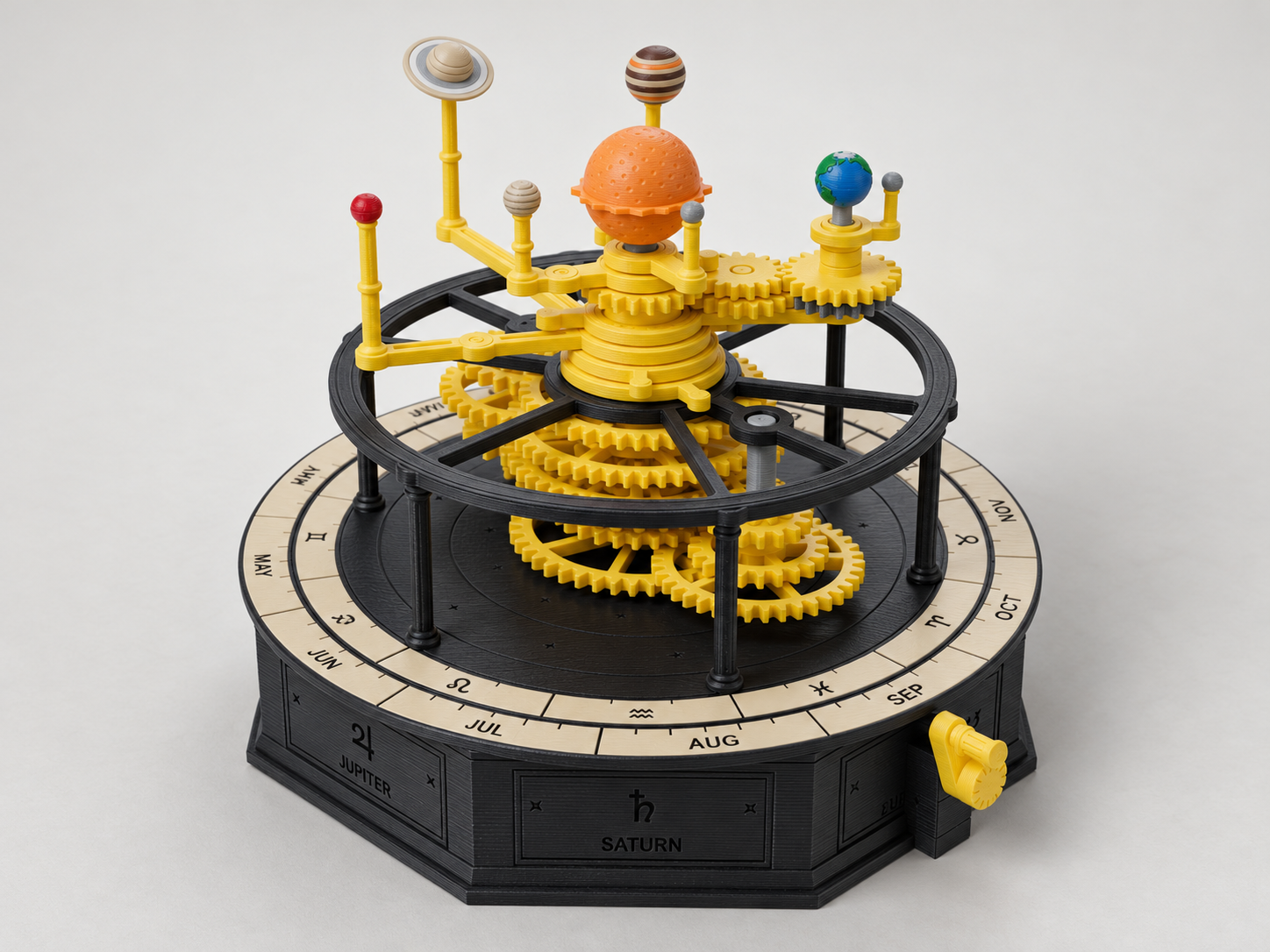
🪐 Mechanical Solar System Orrery – One Crank, Eight Movements! Turn ONE crank and watch the entire solar system come to life! ⚙️ Inspired by the beautiful mechanical planetariums of the 18th century, this fully functional orrery combines astronomy, engineering and classic clockwork design. Watch Mercury race around the Sun while Saturn slowly follows its orbit. At the same time, the Moon circles Earth and Earth rotates on its own axis. Eight movements, one hand crank, no motors or electronics! Boost Me🪐 Enjoying the Mechanical Solar System Orrery? A Boost is a wonderful way to support my work and helps me keep designing and releasing new, creative and functional 3D-printable models! 💛 Every Boost brings more ambitious mechanical projects one step closer. Thank you! ⚙️🚀⚙️ One Crank – Eight Movements Every planet moves according to a carefully calculated gear ratio. Celestial bodySimulated orbital periodMercury88.11 daysVenus224.66 days🌍 Earth365.26 daysMars684.9 daysJupiter11.867 yearsSaturn29.455 years🌙 Moon29.530 days around Earth🌍 Earth's axial rotationApprox. 18 rotations per yearJust 6 turns of the crank simulate one Earth year! Turn the crank counter-clockwise to move forward in time, or reverse it to travel backward. 🔧 Real Gear-Driven Mechanics The entire orrery is powered by a single mechanical drive. Seven nested rotating tubes independently transmit movement to the planetary arms and Moon mechanism. Three compound gear wheels distribute power through the open gear tower. Carefully selected gear ratios reproduce astronomical orbital periods with very small deviations. Each gear pair uses a shared centre distance with individually selected tooth sizes. The visible gear tower showcases the entire mechanical system. No motors, batteries, screws or metal bearings required. 📊 Gear Ratio Accuracy BodyGear trainModel periodReal periodErrorMercury2.4 × 38/2288.11 d87.97 d−0.16%Venus2.4 × 21/31224.66 d224.70 d+0.02%Earth2.4 × 15/36365.26 d365.26 d0%Mars2.4 × 10/45684.9 d687.0 d+0.31%JupiterMars × 24/31 × 10/4911.867 yr11.862 yr−0.05%SaturnJupiter × 26/22 × 15/4429.455 yr29.457 yr+0.006%MoonMercury × 43/10 × 18/24, then 1:129.530 d29.531 d+0.003%The initial 2.4 ratio represents the drive shaft's turns per simulated year, calculated from six crank turns and the 12/30 crown gear. 📅 Set the Solar System to Any Date The planetary arms can be repositioned independently using a mechanical indexing system. Each arm has 24 indexed positions, allowing adjustments in 15° increments. Simply lift an arm, rotate it to the desired position and press it back into place. The model is initially configured for January 1, 2027, using mean heliocentric longitudes: Mercury: 289° Venus: 141° Earth: 100° Mars: 123° Jupiter: 134° Saturn: 20° The engraved zodiac ring provides a reference for planetary positions, with 0° corresponding to Aries (♈). The calendar ring helps you follow the simulated date using the direction from the Sun to Earth. 🪐 Beautiful Planetary Details – AMS Multicolor The orrery combines intricate mechanical engineering with carefully designed multicolor planets. Planetary details include: ☀️ Sun: Textured surface with a sculpted ring of flames. Mercury: Detailed cratered surface. Venus: Distinctive planetary appearance. 🌍 Earth: Realistic coastlines based on Natural Earth data and detailed polar caps. 🌙 Moon: Cratered surface orbiting Earth. Mars: Detailed surface with a white polar cap. Jupiter: Multicolor cloud bands and the Great Red Spot. Saturn: Beautiful tilted rings with the Cassini division. Additional design features: Elegant open gear tower with six turned columns. Decorative spoked gears inspired by antique brass mechanisms. Octagonal display base. Engraved planet names and symbols. Calendar and zodiac rings with sand-colored inlays. Individually marked planetary arms. The AMS allows the intricate planetary and decorative color details to be printed directly into the model. 🖨️ Printing & Assembly Designed for detailed AMS multicolor printing and mechanical assembly. ✅ AMS multicolor printing for the planets and decorative details ✅ 47 printed parts ✅ 12 print plates ✅ No supports required ✅ No glue required – snap-fit and press-fit connections ✅ No screws, metal bearings or motors ✅ Hexagonal connections with crush ribs ✅ Detailed 44-step illustrated assembly guide included Additional material: Three short pieces of ordinary 1.75 mm filament, approximately 10 mm each, are used as connecting pins. Assembly tip: Apply a small amount of plastic-compatible dry PTFE lubricant to the rotating tubes and pins if needed to reduce friction. Avoid excessive lubrication. 📏 Dimensions & Specifications SpecificationDetailsBase width (corner to corner)244 mmTotal height176 mmMaximum Saturn orbit radius128 mmPrinted parts47Print plates12Multicolor printingAMSSupportsNot requiredGlueNot requiredAssemblySnap-fit / press-fitMechanical driveManual hand crankMoving functions8Assembly instructions44 illustrated steps🔭 Scientific Accuracy – Important Information Orbital periods are based on real astronomical data, but planetary sizes and distances are not to scale. The model uses circular orbits and mean orbital motion for its mechanical simulation. Earth's axis remains upright, and its axial rotation is intentionally slowed to approximately 18 rotations per simulated year rather than 366. This makes the movement easier to observe while keeping the mechanism manageable. The 23.4° axial tilt and seasonal variations are not represented in this orrery. The model is intended to demonstrate planetary orbital periods, relative movements and mechanical gear ratios in an engaging, interactive way. 🚀 Perfect For Astronomy and space enthusiasts STEM education and classrooms Mechanical engineering demonstrations Interactive science displays Clockwork and gear enthusiasts Unique desktop decorations Creative gifts Educational 3D-printing projects 🌌 Explore More Space Models Looking for more space-themed 3D prints? 🚀 Discover my other rockets, spacecraft and mechanical space models in my collection: https://makerworld.com/de/collections/26819313-space 💛 Support Future Mechanical Projects Enjoying this mechanical solar system? If you like the model, please consider leaving a Boost! Every Boost supports my work and helps me continue developing and publishing new, creative and functional 3D-printable models. Your support means a lot and makes more ambitious mechanical projects possible! 📸 Printed your own orrery? I'd love to see your finished model! Feel free to share a Make, photo, rating or constructive feedback. Thank you and happy printing! 🪐⚙️
Tags
Diseñador
TundraGold