
Print-in-Place Roller Bearing 608 No Support
Peso
3g
Tiempo
19m
Precio
Cotiza este producto por WhatsApp
Contáctanos y te damos el precio según color y acabado
Las dimensiones dependen del diseño. Confirmamos las medidas exactas por WhatsApp.
Descripción
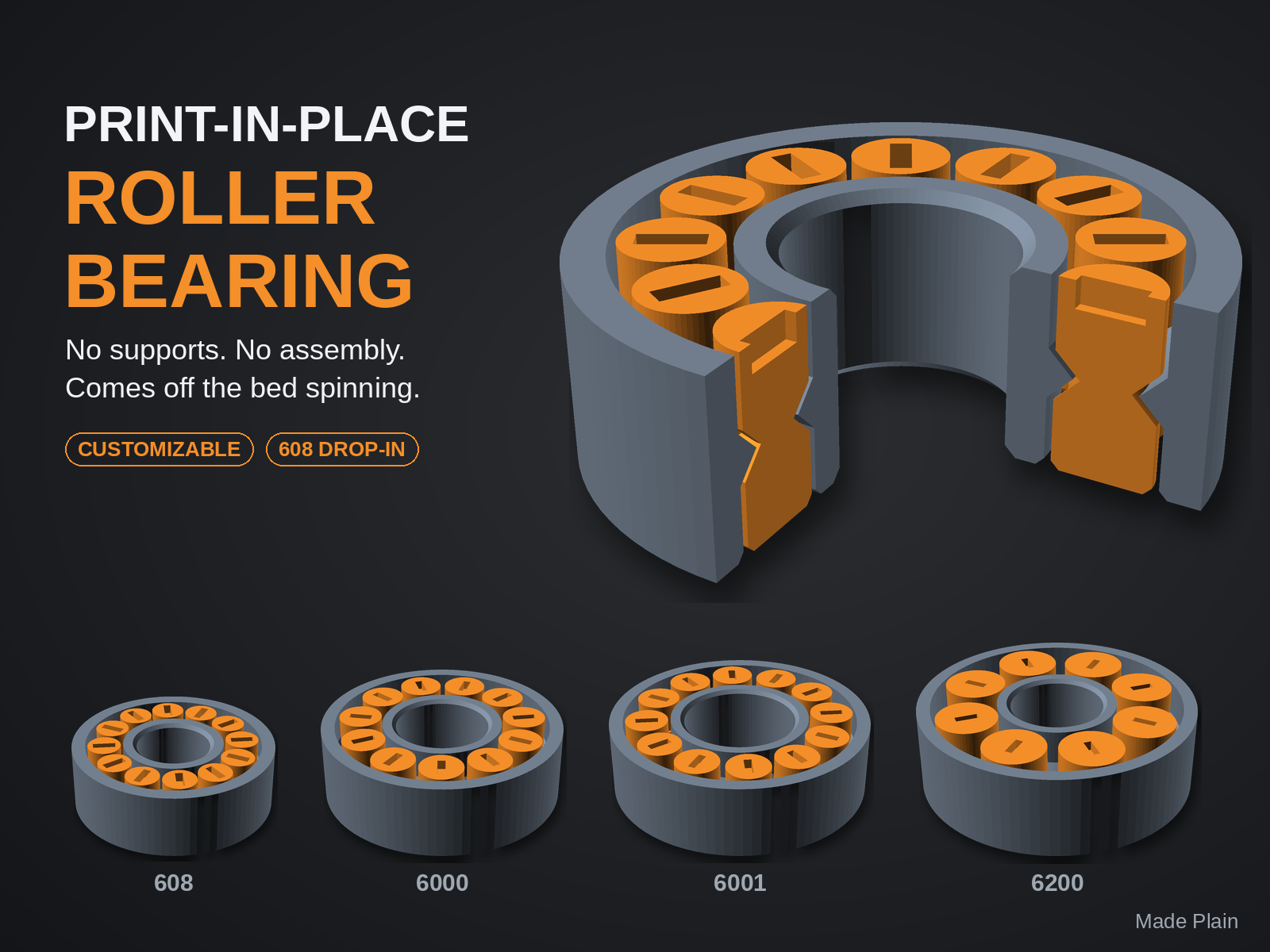
**Prints assembled, spins right off the plate.** This roller bearing prints in one piece with every roller already trapped between the rings. Pop it loose with a twist and it spins. No supports, no glue, no steel balls. **Why it doesn't fall apart** Most printed bearings either fuse solid or drop their rollers. This one does neither: - Every roller has a V-groove around its middle, and both rings have a matching V-ridge that sits inside it. The rollers can't fall out and the rings can't be pushed apart. - The ring is packed full of rollers, so they can't bunch up on one side. - Every roller stands on its full diameter on the bed, so nothing gets knocked over mid-print. - All overhangs are 45° or less, and the bottom edges beside every gap are chamfered so first-layer squish doesn't weld parts together. **If a roller sticks** Each roller has a small screwdriver slot on top. Give a stuck one a gentle twist and it's free. **Sizes** | Preset | OD × bore × thickness | Rollers | |---|---|---| | 608 (default, skate / fidget spinner size) | 22 × 8 × 7 mm | 12 | | 6000 | 26 × 10 × 8 mm | 11 | | 6001 | 28 × 12 × 8 mm | 12 | | 6200 | 30 × 10 × 9 mm | 8 | | Custom | your numbers | as many as fit | All four presets plus a 19 × 6 × 5 mm custom size have been printed and tested (photos). **Customize options** - **Gap:** 0.25 mm default. Range 0.20–0.30 mm. Go tighter if yours feels loose, looser if it's hard to break free. [confirm which gaps you'd recommend after T2 (0.20) and T3 (0.30)] - **Bore extra:** opens the bore slightly if it's tight on your shaft. - **Roller slot:** on by default. - **Engrave gap:** writes the gap size on the outer edge, handy when testing fits. - **Bottom chamfer:** leave at 0.3 unless your first layer runs very squished (raise it) or very light (lower it). - The model checks your custom numbers and tells you if a bearing would be too small or too thin to hold together. ## Print settings - **Material:** PLA (tested). PETG should work but hasn't been tested. - **Nozzle:** 0.4 mm - **Layer height:** [0.20 mm — confirm what you printed at] - **Supports:** OFF (supports will weld it solid) - **Brim:** off, or outer brim only, nothing touching the rollers - **Elephant foot compensation:** ~0.15 mm (this matters most) - **Seam:** random or back - **Printer used:** Bambu Lab H2D ## After printing 1. Hold the outer ring and turn the inner ring with a pencil or an 8 mm bolt through the bore. It'll feel stiff for the first turn or two. 2. If a roller won't budge, twist it by its slot. 3. Spin it for a minute to break it in. A drop of dry PTFE lube makes it smoother. ## For fidget spinners and other projects - For a press-fit hole, use 22.2–22.3 mm for the 608 size. The outer ring is thinner than a steel bearing's, so a tight press can squeeze the rollers. - Finger caps should touch only the inner ring. - Even better: drop this bearing straight into your design so the bearing prints in place as part of the body. (My holiday tri-spinners do exactly that. https://makerworld.com/en/models/3380532-halloween-fidget-spinner-print-in-place-bearing#profileId-3846147
Tags
Diseñador
TriDim Forge