
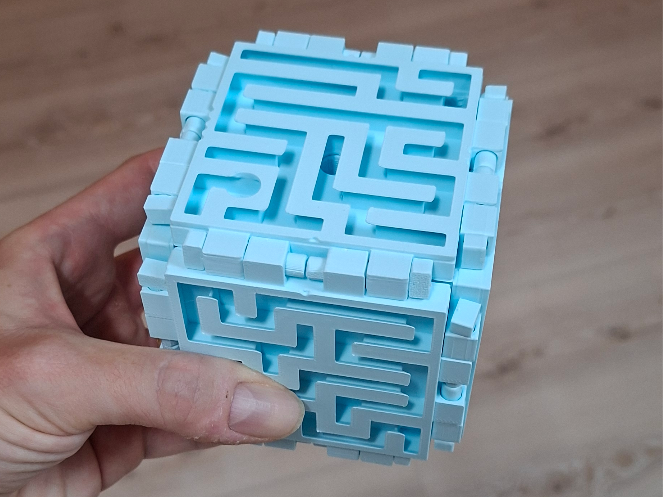
The Hidden Maze Cube – Expandable 3D Marble Puzzle
Peso
189g
Tiempo
6h 52m
Precio
Cotiza este producto por WhatsApp
Contáctanos y te damos el precio según color y acabado
Las dimensiones dependen del diseño. Confirmamos las medidas exactas por WhatsApp.
Descripción
The Hidden Maze Cube – Expandable 3D Marble Puzzle This puzzle starts as a flat kit of interlocking parts and transforms into a three-dimensional maze. Five faces contain the visible parts of the maze, while the sixth face houses a system of hidden tunnels connecting different sections together. Insert the marble through the entrance marked with an X and try to find your way to the exit on the bottom. The path doesn't simply stay on one face: it travels through hidden internal tunnels and reaches every face of the puzzle at least once. Some of the connections are therefore completely invisible from the outside. Expandable The puzzle is designed as a reusable platform. The base, connectors and hidden tunnel system are shared between different maze layouts. This means that new mazes can be created in the future by replacing only the five maze faces. Instead of printing the entire puzzle again, you can simply print the five new maze faces, disassemble the existing puzzle, and assemble them onto the same base and tunnel system. Everything uses snap-fit connections, making the puzzle easy to disassemble and rebuild. Assembly The model is provided as a flat kit of parts that are assembled by fitting them together. No glue or additional hardware is required. An Educational Approach: Solving the Maze with Graph Theory This is not just a 3D maze — it can also be approached as a graph theory problem. Each cell of the maze can be represented as a node, while every possible passage between two cells becomes an edge connecting those nodes. The hidden tunnels are simply connections between nodes that happen to pass through the inside of the structure. If you want to solve the maze mathematically, you can try breaking the problem down into two steps: 1. Reconstruct the graph Look for the hidden connections between cells. Some passages are visible, while others pass through the internal tunnels and connect cells on different faces. Try to identify which cells are connected and draw those connections on paper. You are essentially turning the 3D maze into a graph. 2. Find a path through the graph Once you have reconstructed the graph, finding the solution becomes a matter of finding a path from the entrance to the exit. The interesting part is that you can do this on a two-dimensional sheet of paper, even though the physical maze exists in three dimensions. The geometry of the cube doesn't change the underlying graph — it only changes how the graph is laid out in space. So before reaching for the solution, try drawing the graph yourself. You might discover that a seemingly complicated 3D puzzle becomes much easier once you look at it from a mathematical point of view. Maze generation The maze was procedurally designed starting from a generalized graph representation, where holes and passages can be treated as connections between nodes. Once the topology was defined, the solution path was generated according to a set of constraints. The maze was then populated with progressively smaller dead ends branching away from the main paths. I won't describe the constraints here — doing so would take away part of the fun of solving it. Compatibility & Printing The kit card has a footprint of 256 × 256 mm, so the complete kit can be printed as a single piece on a printer with a build plate of at least this size. For smaller printers, the model is also provided with the individual parts and the structure as separate objects. This allows the pieces to be arranged and printed individually using a more traditional printing setup.
Tags
Diseñador
gclst