
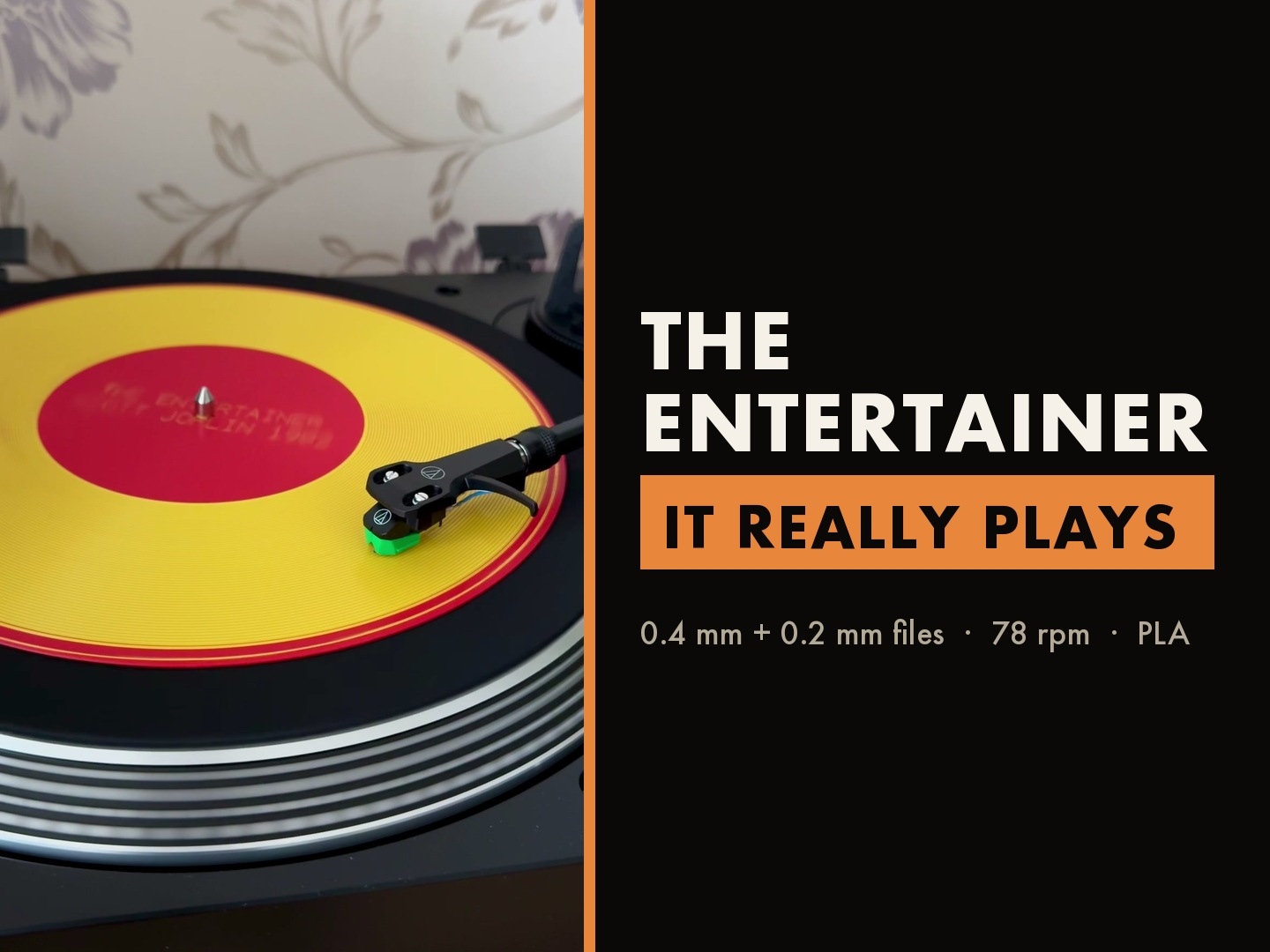
Playable 3D Printed Record - The Entertainer
Peso
104g
Tiempo
2h 55m
Precio
Cotiza este producto por WhatsApp
Contáctanos y te damos el precio según color y acabado
Las dimensiones dependen del diseño. Confirmamos las medidas exactas por WhatsApp.
Descripción
A record that actually plays: The Entertainer (Scott Joplin, 1902) This is a record. You print it, put it on a turntable at 78 rpm, and it plays The Entertainer. Printed records are usually a gimmick, and the reason is fair: a printer resolves 0.2 mm in Z, a record groove is 28 µm deep, so modulating the groove up and down leaves about two bits of amplitude. The groove in this model moves sideways instead, in XY, where the motion is continuous and there are no layers at all. The limit becomes how tightly an extruded bead can turn, which was measured on a printed disc rather than guessed. Be clear about what you are getting: it is lo-fi. The usable band ends between roughly 550 and 1000 Hz depending on the file and where the needle is, so you get the melody and there is audible surface noise underneath. You will recognise it from across the room, and that is the point. Hear it first: youtube.com/shorts/Oa8asXuxjOY Boost MeThis model is free to download and print. If you enjoy it, a free boost really helps. ❤️Files FileNozzleLayerAudio on the discDiameterentertainer-0.4mm.3mf0.4 mm0.20 mm16 s250 mmentertainer-0.2mm.3mf0.2 mm0.10 mm30 s250 mmThe 0.2 mm file holds almost twice the music on the same disc, because a finer nozzle needs less room between grooves, and it carries the band higher too. Both carry the title raised on the label. Both are ordinary solids: you slice them with your own profile, so nothing here bypasses your printer settings. Want a different song, your own music, or a smaller disc for a smaller bed? The generator linked below writes ready to print G-code straight from an audio file, so no slicing is needed at all. That is also the quicker route for a 0.2 mm nozzle: a fine groove is a lot of geometry for a slicer, and the generator skips the slicer entirely. Two colours, the easy way The base of the disc is a flat slab and the grooves stand on top of it, so one filament change in your slicer gives the two colour look: base in one colour, grooves and label text in the other. No painting, no multi-part assembly. entertainer-0.4mm.3mf: add the filament change at 1.30 mm entertainer-0.2mm.3mf: add the filament change at 0.85 mm In Bambu Studio, right click the layer slider at that height and choose "Add filament change". With an AMS the printer does it by itself; without one it pauses and waits while you swap the spool. Printing it in a single colour works exactly as well, the grooves just blend in. Print settings PLA. Not PETG, not TPU: the groove has to stay hard and dimensionally stable. 100% infill, or at least enough solid layers that the groove floor is solid. No supports, no raft. Brim optional. Do not scale the model. Diameter, groove pitch and playback speed are one calculation; scaling breaks the timing and the groove shape. Both files need a 256 mm bed. For a smaller printer, generate a smaller disc with the tool below; do not scale these. A groove is a lot of geometry, so slicing takes longer than a normal model: about a minute for the 0.4 mm file, a few minutes for the 0.2 mm one. Give it time before you assume something is wrong. Slow down the outer walls if your profile is aggressive. The groove walls are the record; ringing on them is noise you will hear. Watch the first layer. A patchy base means a bad groove, and you are hours from finding out. Playing it 78 rpm. At any other speed it plays at the wrong pitch. Tracking force about 2 g, anti-skate 2. Lower the needle with the cueing lever onto the wide run-in groove at the edge. Use a cheap cartridge with a replaceable stylus. PLA is softer than vinyl and wears a needle faster. Treat the needle as a consumable and keep your good one for records. If the stylus skates across the surface instead of tracking, lift it straight away. ⚠ Beta. You print and play this at your own risk. This is experimental. Not every printer has been tested, a disc takes hours to print, and a printed record can wear or damage a stylus. If you are not willing to risk a needle, do not print this. Make your own record The generator is open source (MIT) and runs entirely on your own machine, with no account and no server: github.com/TanskiSzymon/vinyl-engine Drop in any audio file, pick the speed and the diameter, add a label and a pattern, and it writes either ready to print G-code or a 3MF like this one. The repository also has the engineering write-up with the measurements behind every number, printer templates for the P1S, and a calibration loop that plays a tuning disc, listens to your own turntable and corrects later discs for what it measured. If you would rather have an AI agent set it up for you, there is a brief for that in the repo too. Contributions are welcome. The music is synthesised from notes rather than sampled, and Scott Joplin published The Entertainer in 1902, so the composition is in the public domain.
Tags
Diseñador
Tansky