
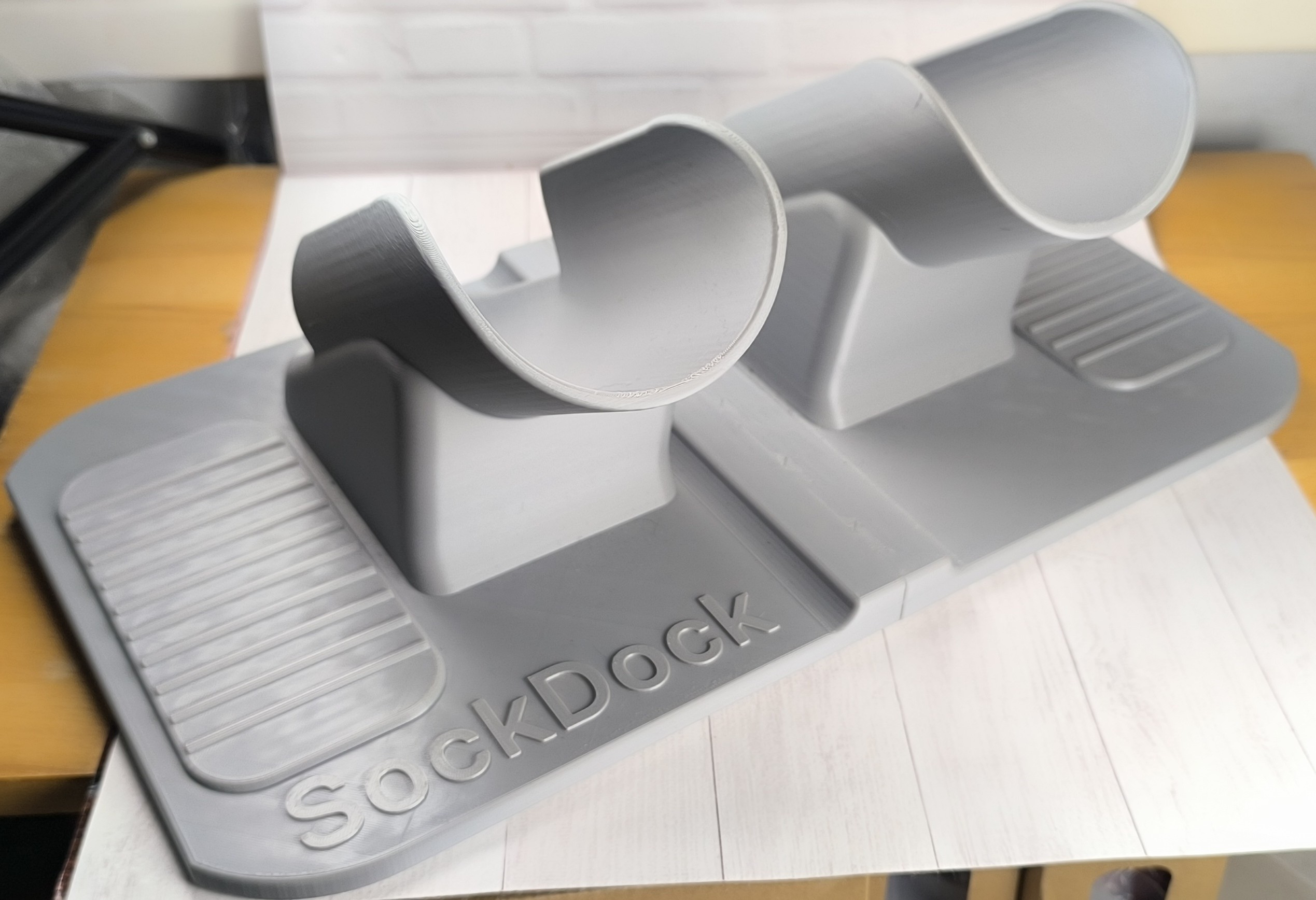
SockDock — Hands-Free Sock Station (SecondSock)
Peso
1024g
Tiempo
26h 32m
Precio
Cotiza este producto por WhatsApp
Contáctanos y te damos el precio según color y acabado
Las dimensiones dependen del diseño. Confirmamos las medidas exactas por WhatsApp.
Descripción
SockDock — Hands-Free Sock Station (SecondSock) Sock Dock is a 3D-printable hands-free station developed for the SecondSock design brief in the Make for Good contest. Its goal is to make everyday dressing easier for people who use their feet instead of their hands. Two inclined supports allow both socks to be prepared in advance and put on one at a time. Side platforms help stabilize the station with the opposite foot. This is especially useful for the second sock: the foot already wearing a sock holds the base steady without needing to grip the fabric. Model Features Rounded edges for contact with fabric. Modular construction with a sliding dovetail connection. Mounting recesses for rubber feet, with optional TPU-printable feet included. A simple design with no moving mechanisms. Stability and Mounting Options Choose the option that works best for your setup: 3D-printed TPU feet: The model includes 19.4 mm diameter feet for printing in TPU. Attach them inside the mounting recesses using double-sided tape. Grip will depend on the filament and floor surface. Self-adhesive rubber feet: The recesses are 20 mm in diameter and 2 mm deep, designed around these rubber feet (alternative supplier), which I already had on hand. Attachment to a small mat: Use suitable double-sided tape to attach the base to a small non-slip mat. Check that the tape holds securely and that the mat itself does not slide. Screw mounting: Use the 4.5 mm mounting holes to attach the base to a suitable wooden surface with 3.5–4 mm countersunk screws. Choose a screw length appropriate for the surface and avoid overtightening. Before use, check that the station sits evenly and remains securely in place. If you have different rubber feet, send me their dimensions—I’d be happy to adapt the mounting recesses to fit them. Assembly Join the base sections using the sliding dovetail connection and fit the feet into the mounting recesses. Assistance may be needed during the initial assembly: different filaments shrink by different amounts, so the connection may require minor adjustments. Avoid forcing the parts together. The station only needs to be assembled once and does not need to be taken apart between uses. Daily sock loading and use are intended to be performed with the feet. How to Use The station is designed for seated use. Use your toes to position both socks on the supports. Hold the station steady with one foot on the side platform while guiding the other foot into the prepared sock. Once the first sock is fully clear of the support, switch feet and repeat for the second sock. Before use, check that the station sits evenly and grips the floor securely. A Useful Technique Position the sock cuff at the lower curve of the support, as marked in the GIF. Slide your foot into the sock until your toes reach the toe section. Then lift the toes of that same foot upward to help the cuff slip off the support and onto your foot. This movement may take a little practice to get used to. Print Profiles Reinforced — 4 Walls, 15% Gyroid Layer height: 0.2 mm Wall loops: 4 Top shell layers: 6 Bottom shell layers: 5 Infill pattern: Gyroid Infill density: 15% Supports: Normal (Auto) Support style: Snug Lightweight — 2 Walls, 5% Gyroid Wall loops: 2 Top shell layers: 5 Bottom shell layers: 3 Infill pattern: Gyroid Infill density: 5% Supports: Normal (Auto) Support style: Snug My original prototype was printed and tested using the lightweight settings in JAMG HE ECO PLA+. It held up well throughout my testing—I certainly gave it plenty of homework! Build Plate Recommendations A Bambu Cool Plate SuperTack is recommended when compatible with your chosen filament, or use a thoroughly cleaned, suitable build plate. The model has a wide base, making good first-layer adhesion especially important. Before printing, clean the plate according to the manufacturer’s instructions and select the appropriate plate profile and bed temperature. Project Development SockDock is a working prototype. In my own testing, I successfully put on every pair of socks in my home using it (not a single sock was harmed!). Compatibility with longer socks is still being evaluated. Broader testing with different users is the next step. Feedback from people who use their feet to put on socks is especially valuable—your experience can help make SockDock more comfortable and practical.
Tags
Diseñador
Ravenkov Studio 🐦⬛