
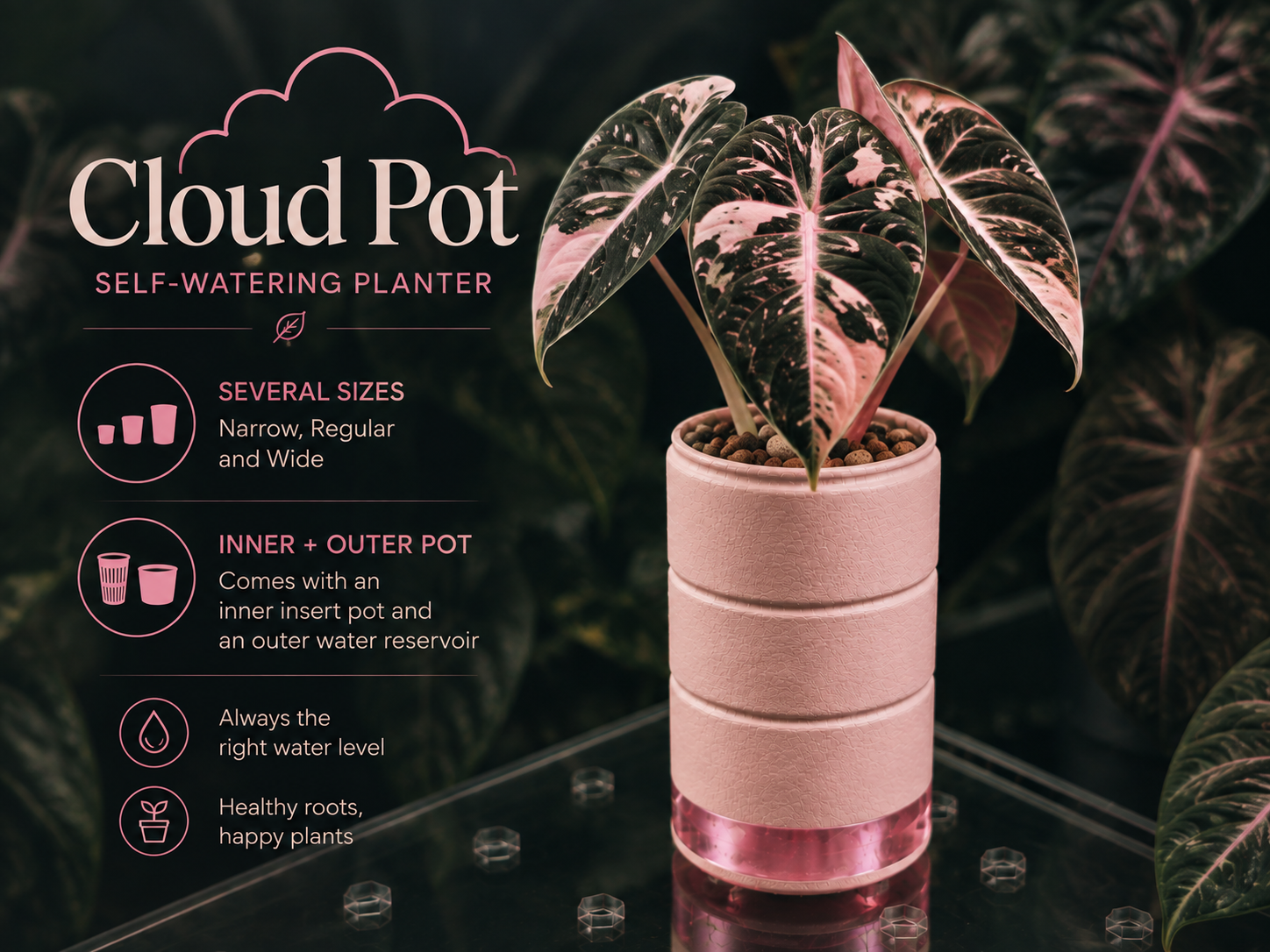
Cloud Pot – Self-Watering Plant Pot
Peso
439g
Tiempo
21h 14m
Precio
Cotiza este producto por WhatsApp
Contáctanos y te damos el precio según color y acabado
Las dimensiones dependen del diseño. Confirmamos las medidas exactas por WhatsApp.
Descripción
☁️ Cloud Pot — Self-Watering Planter ⚠️ PERSONAL USE ONLY These files are currently licensed for PERSONAL, NON-COMMERCIAL USE ONLY. You may print Cloud Pots for yourself or as gifts. Selling physical prints or otherwise using the files commercially is not permitted under the current license. A separate commercial license is planned and will be available soon. Meet the Cloud Pot — a self-watering planter for semi-hydro growing. The name came from a dear friend who tested the design and said its shape reminded her of a little cloud. ☁️ The model comes in 3 original sizes: Narrow — I use it mainly for Alocasias Regular — a larger everyday size for Alocasias and other aroids Wide — perfect for Anthurium cuttings and plants that prefer a wider root area Each plate contains an insert + outer water reservoir. If you only need to print one of them, simply hide the other object on the build plate before slicing. The outer pot consists of 3 parts: the main body, bottom, and a small translucent section that acts as a water-level window, making it easy to see when the reservoir is running low. No multicolor setup? No problem. If you can't print in multiple colors, or simply don't want a visible water-level window, assign the translucent part the same filament/color as the rest of the outer pot and print it as one solid-color design. Once printed, the only extra thing you need is a wick. 🌱 📐 Resizing The pots can easily be scaled up, made taller or wider to suit your plants. Scale the insert and outer pot consistently to preserve their fit. Important: after resizing, copying or modifying the model, always check the object's print settings before slicing. Some slicers may revert copied/modified objects to default settings, which can affect watertightness. 💧 Material & Print Settings The Cloud Pots were designed and tested with PETG, which is my recommended material for the outer reservoir. The included print settings have been tested over the course of several weeks, with the pots continuously holding water. No leaks or other water-related problems were observed. For the best results: Use good-quality, dry PETG. Moist PETG can cause bubbling, inconsistent extrusion and tiny imperfections that may compromise watertightness. Use at least 5 wall/perimeter loops. Use at least 5–6 bottom layers. Make sure your filament profile provides good, consistent extrusion and layer adhesion. Always leak-test the outer pot before adding your plant. The provided file already contains the settings used for my tested prints. If you use another slicer, please configure equivalent settings manually. Important: make sure Fuzzy Skin is NOT applied to the translucent water-level window. Fuzzy Skin makes the surface less transparent and can make it difficult to see the water level clearly through the window. Why PLA is not recommended? PLA can hold water when printed well, but I don't recommend it for a long-term water reservoir. PETG offers better toughness, layer adhesion and durability for a functional pot that stays continuously filled with water and nutrient solution. Other materials may also work, but I have only tested and can recommend PETG. If your print isn't watertight, first check your filament condition and quality, extrusion, layer adhesion, and print settings. If you choose to seal it instead, use only a fully cured waterproof coating explicitly suitable for prolonged water contact and safe for the intended application, such as an appropriate aquarium-safe coating or food-safe epoxy (remember that roots can eventually grow directly into the reservoir). I'd love to see your prints, plants and custom sizes — happy growing! ☁️
Tags
Diseñador
aroid.cabinet