
Parametric Name Plate for Round Bases (25–60 mm)
Peso
1g
Tiempo
17m
Precio
Cotiza este producto por WhatsApp
Contáctanos y te damos el precio según color y acabado
Las dimensiones dependen del diseño. Confirmamos las medidas exactas por WhatsApp.
Descripción
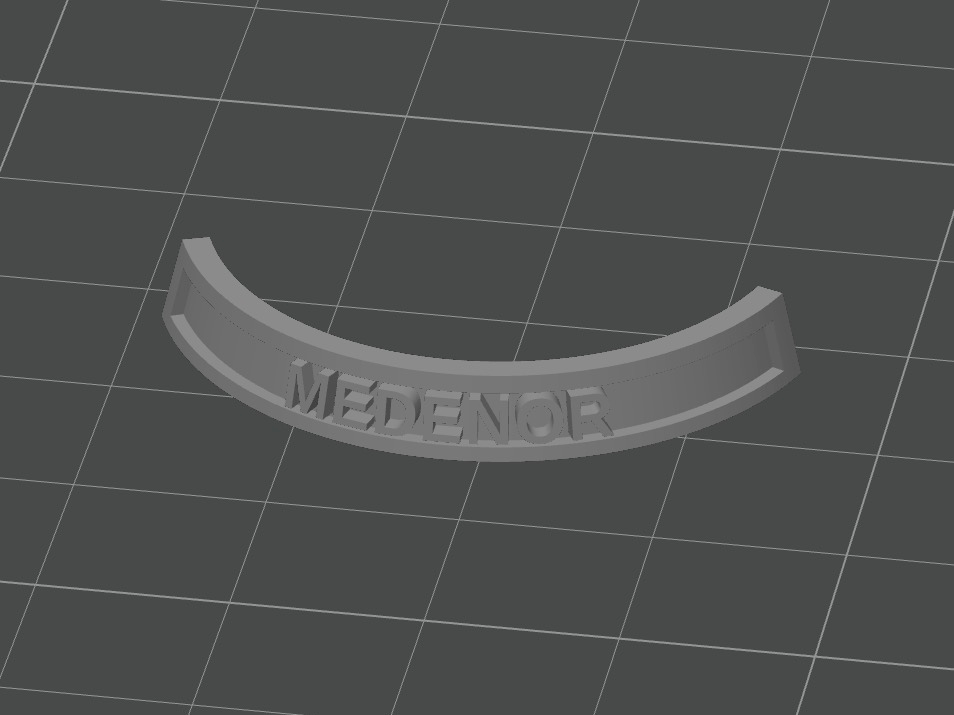
Parametric Name Plate for Round Miniature Bases — 25 / 32 / 40 / 50 / 60 mm A curved name banner that clips around the front of a round miniature base. Type a name, pick a base size, download. Nothing else to model. The plate is a 140° conical collar with a recessed panel, a raised frame, and the name standing proud of that frame. Every dimension is exposed as a parameter, so you can match it to your own basing style instead of settling for mine. Why parametric and not a folder of 200 STLs: a name plate is only useful with your name on it. Squad leaders, kill team operatives, retinue characters, D&D party members, display pieces — they all need different text on the same geometry. The customizer generates exactly the one you need, correctly sized for the base it goes on. Base sizes The arc angle stays at 140° across all sizes, so the plate always covers the same proportion of the base and the proportions stay visually consistent. Only the developed length changes: BaseCommon useText area (developed)25 mmSmall infantry29.4 mm32 mmStandard infantry38.0 mm40 mmMid-sized infantry & characters47.8 mm50 mmLarge infantry & teams60.0 mm60 mmMonsters & small vehicles72.2 mmAny other diameter works too — the field is a plain number, not a fixed list, so 28 mm, 55 mm or 90 mm are all fine. Long names are handled automatically: cap height is capped so the letters never touch the top and bottom rails, then the whole string is scaled down if it still runs past the side posts. An 18-character name fits a 25 mm base at about 80 % scale, and fits every larger size at full size. How it stays on the base The inner surface is a cone, not a cylinder. At the bottom edge it sits 0.42 mm clear of the base radius; going up, it closes in by 14.2°. You slide it on from the top and the taper wedges it in place — no clip, no magnet, no glue needed on a standard base. Two parameters cover the rest: jeu (clearance) — raise it if your printer runs tight or your bases are chunky. 0.42 mm is a good starting point for a 0.2 mm nozzle. inclinaison (lean) — set it to 0 for a straight cylindrical collar that slides on freely and takes a drop of glue instead. Useful for resin bases with sharp vertical walls, or if you want to remove and swap plates. Parameters Everything below is in the OpenSCAD customizer, grouped into four sections. Text nom (the name) · police (font) · hauteur_capitales (cap height, 2.35 mm) · relief_texte (letter relief, 0.90 mm) · espacement (extra letter spacing) · marge_texte (clearance between letters and rails) · grave (engraved instead of raised) Base diametre_base (dropdown: 25 / 32 / 40 / 50 / 60) · jeu (radial clearance) Plate angle_arc (140°, goes up to a full 360° ring) · hauteur (4.45 mm) · epaisseur (1.45 mm wall) · inclinaison (14.2° lean) Frame profondeur_creux (0.70 mm panel recess) · bandeau_bas / bandeau_haut (bottom and top rail height) · montant (side post width) Print settings Print it standing upright, bottom edge flat on the plate — that is the orientation the file comes in. Nothing to rotate, nothing to support: the inner face sits at 76° to the bed, well inside the overhang limit. The name is a vertical wall feature, so layer height is what defines its crispness, not nozzle diameter alone. Verified profile (this exact setup produced the printed part in the photos): PrinterBambu Lab X2DNozzle0.2 mmLayer height0.08 mm (0.1 mm first layer)Profile0.08 mm High QualityMaterialPLAWalls4Infill15 % gyroidBrimOuter only, 5 mmSupportsNoneFootprint12.3 × 33.6 mm on a 32 mm plateMaterial used~0.25 gA 0.4 mm nozzle at 0.12 mm should also works — expect softer letter edges on 2.35 mm capitals. Below 0.16 mm layer height the text starts to lose definition. Multi-colour (AMS): you get a two-tone plate with zero modelling work by inserting a filament change at the panel floor and a second one at hauteur - bandeau_haut. Because the letters stand 0.2 mm proud of the frame, a third change over that last 0.2 mm picks out the name on its own. Fonts Letter positioning uses a per-character advance-width table calibrated for Helvetica / Arial Bold metrics (Liberation Sans Bold, which ships with OpenSCAD, is metrically identical). Stay in that family and spacing is correct. If you switch to a font with very different proportions, two constants at the top of the file need re-measuring — the file explains exactly how, in three lines. It is a one-minute job, not a rewrite. What you get The OpenSCAD source, fully commented, every dimension parametric Ready-to-print STLs for the five standard base sizes as examples Renders clean under OpenSCAD version 2026.04.26.
Tags
Diseñador
Medenor