
Jitterbug mechanism - Foldable Polyhedron Fidget
Peso
8g
Tiempo
36m
Precio
Cotiza este producto por WhatsApp
Contáctanos y te damos el precio según color y acabado
Las dimensiones dependen del diseño. Confirmamos las medidas exactas por WhatsApp.
Descripción
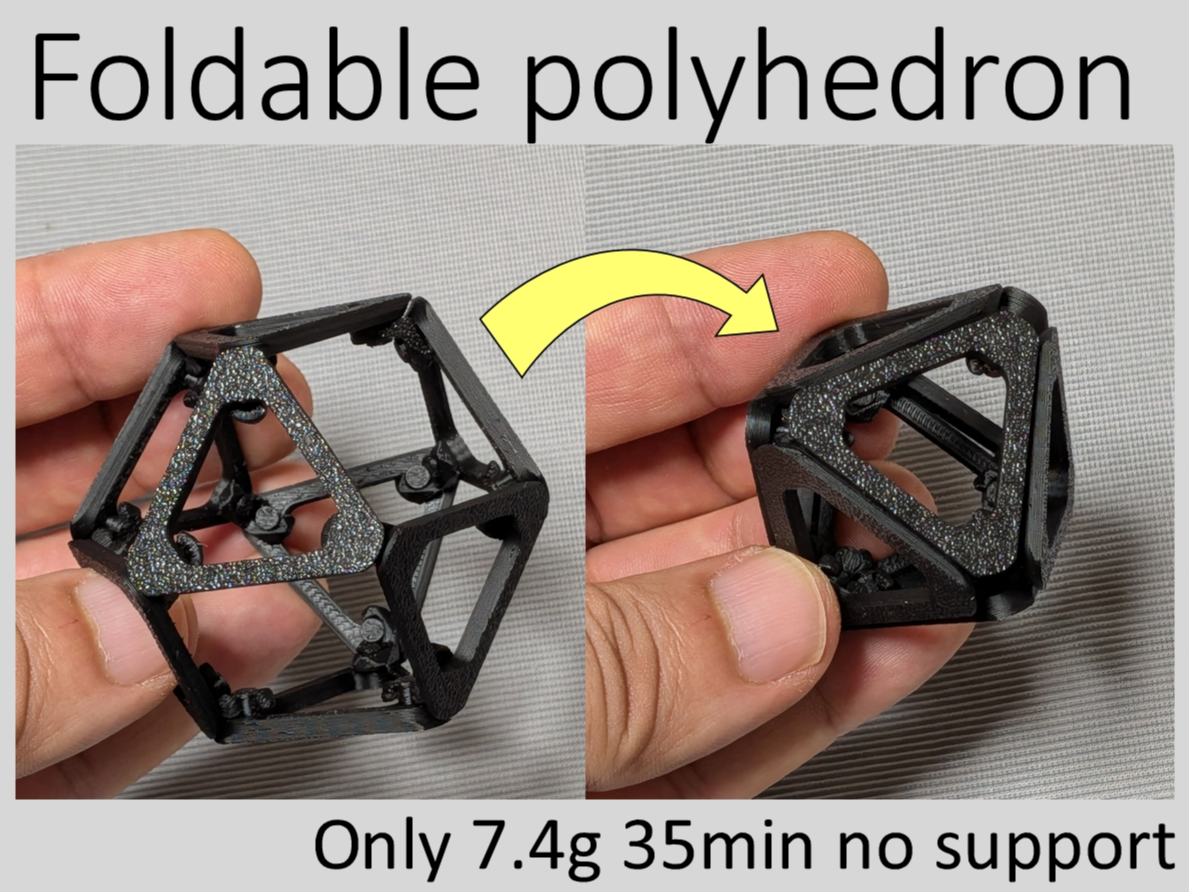
Jitterbug Mechanism Jitterbug mechanism is a foldable polyhedron. The name “jitterbug” is given after the twisting motion of the triangles during folding/unfolding, with maintaining the link with the neighboring triangles. They look dancing a jitterbug dance, don't they? When it is folded, it is a regular octahedron, which has eight triangular faces. When it is unfolded, it has eight triangles and six squares. It can be regarded as a cube with its vertices trimmed. During the folding process, the square is folded in half on its diagonal line. The mechanism is easier to understand in the unfolded shape. There, each vertex of a triangle is linked to the other vertex of adjacent triangle with a virtual ball joint. In this model, the virtual ball joint at the exact vertices is imitated by two rotational joints near the vertices. Two models Two models with different clearance settings are provided. A model with 0.03 mm radial clearance has smoother motion. A model with zero clearance has less play. It also gives smooth motion just by the elasticity of the material. Printing Material: Both PLA and PETG should work. Eight triangles and twelve jointing parts should be printed. No support is needed even for the joint. Note the position of the joint on the plate. Less than 8g filament and 40min printing time is required for printing. Assemble Just push the shaft into the hole to snap assemble the joints. Assemble the triangles so that you have square-shaped openings between them. 150% scaling I also tried 150% scaled print. The black one is the original. The orange one is 150% scaled, which is more rigid and easy to handle but requires more consumption in filament, time and storage space. How to fold/unfold the model Unfolding is easy. Just pull the two opposite triangles apart. Folding is sometimes a little tricky because when the model is at the symmetry position, it resists the compressive force on the opposite triangles. In such a case, rotate one of the side triangle to help breaking the symmetry. In this gif animation, I push and pull the opposite triangles by the pointing fingers and help rotation of a side triangle by the thumb of the left hand. Note that the opposite triangle do not rotate relatively to each other. They just do parallel movement toward or away from each other without rotation. The other easy way to fold/unfold is to grab two triangles that have one triangle between them (i.e., skip one triangle), and twist them, as shown in the gif animation. So, happy printing!
Tags
Diseñador
osamutake