
PlayGrid - City of Rivals
Peso
1606g
Tiempo
77h 37m
Precio
Cotiza este producto por WhatsApp
Contáctanos y te damos el precio según color y acabado
Las dimensiones dependen del diseño. Confirmamos las medidas exactas por WhatsApp.
Descripción
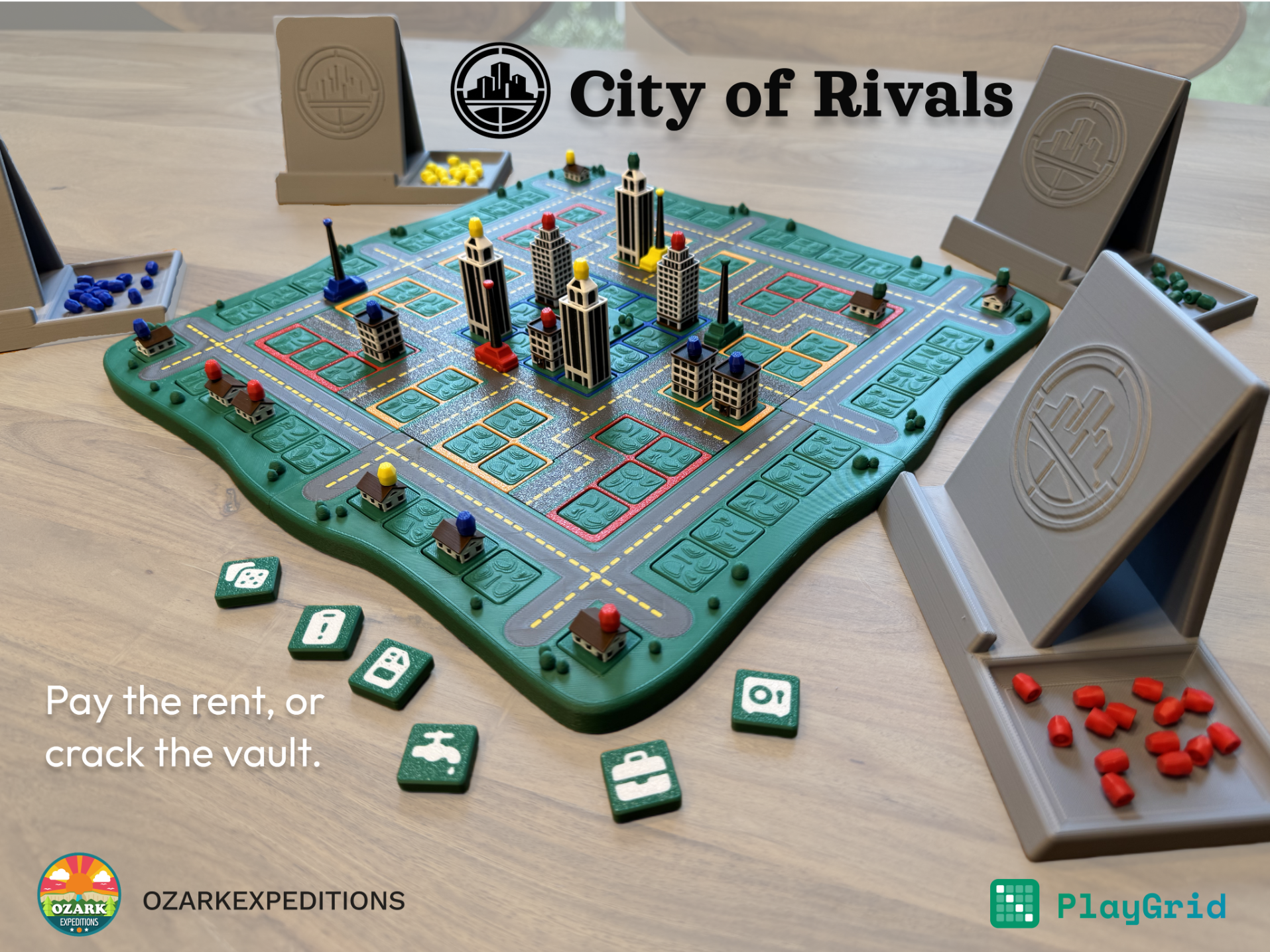
A note from the host: I'm running this contest, so this entry isn't eligible for prizes or placement. I posted it on the final day so it wouldn't influence anyone's submission. I just wanted to build something for it too. :) Beta release. City of Rivals is playable start to finish, but it's still being tuned - rent amounts, heist odds, and mission difficulty are the parts most likely to change. I'm releasing it now because I need real games at real tables to tell me what needs adjusting. If you play it, tell me what felt off. Picture four developers hunched over a city that did not exist twenty minutes ago. One of them just dropped a skyscraper in the Financial District, another is quietly buying up the Industrial blocks nobody wanted, and the player who landed on your building is staring at their phone deciding whether to pay you rent or crack your vault. City of Rivals is a city-building economy game built for the PlayGrid system, made for family game nights, strategy-leaning groups, and anyone who has ever wanted to build a skyline and then charge their friends to walk through it. Design Intent City of Rivals was designed to feel like a real estate empire built on top of a real city grid, where every dollar you spend shows up on the table as a building you can see. Districts get more expensive as you move toward the center, so the board naturally creates pressure, cheap sprawl in the Suburbs or expensive footholds in the Financial District. Buildings you own in the same district feed each other and the map slowly turns into territory instead of a scatter of purchases. Just paying rent is the safe move. Heists, street challenges, and lopsided trades are the interesting ones. Secret missions push players in directions their rivals cannot see, and because a rival has to validate your mission before you get paid. The modular nature of PlayGrid means the city we can keep growing it. Drop a comment on what you would like to see added next. You Will Also Need the PlayGrid Core Module This game is built on top of the PlayGrid Core Module, which provides the base grid that City of Rivals sits on. You will need to print the core module to play this game. Grab it here: https://makerworld.com/en/models/2662193-playgrid-core-module#profileId-2944976 Companion App City of Rivals comes with a free companion app that handles the money, the rent math, the district bonuses, the heist odds, the development tiles, and the secret missions, so nobody is doing arithmetic between turns and nobody is shuffling a stack of cards. It makes game play really easy. Launch the app here: https://ozarkexpeditions.com/games/city-of-rivals This one is a little different from our other companion apps. City of Rivals is fully synchronized, every player joins the same session on their own phone. The host starts a game, names the city, and shares a join code or QR link. From there, everyone sees balances, buildings, and the live city wire feed update in real time. Your missions stay private on your own phone. Your rivals only find out what you were up to when you ask one of them to validate it. A few tips for the best experience: The app is a Progressive Web App, so you can save it to your phone's home screen and launch it like a native app. On iOS, tap the share button in Safari and choose "Add to Home Screen." On Android, tap the menu in Chrome and choose "Install app" or "Add to Home Screen." Once installed, it opens without the browser bars, giving you a cleaner, full-screen experience at the table. Before you start playing, set your phone's auto-lock to Never (or at least a long duration) so the screen does not keep going to sleep between turns. You can switch it back when the game is over. Every player needs their own phone for this one, since missions are secret and heists are live head-to-head picks. The host can tune starting cash, building costs, rent bonuses, mission difficulty, heist rules, and the win condition before the session starts, so you can shape the game around your group. How the Game Works Objective: Build the most valuable portfolio in the city and be holding the most cash when the market breaks. Supports 2 to 4 players and runs about 45 to 90 minutes. Each player starts with a treasury ($3,000 by default), a color, and a secret mission only they can see. On your turn you roll and move across the PlayGrid city, then tell the app what happened. Land on open ground and you can build. Pick a district, pick a building tier, and pay the price. Before the purchase closes, you reveal the development tile under your new lot, which can hand you a windfall, hit you with a fine, or offer you a gamble. Then you place the physical building on the board in your color, and it stays there for the rest of the game. Land next to a rival's building and you owe rent. The app calculates it from the building tier, the district multiplier, and how many connected buildings that rival owns in the district. You can pay it and move on, or you can attempt a vault heist and try to walk away without paying anything at all. Land on a rival and you can call them out. Street challenges let you wager cash on a live head-to-head pick, and the loser pays out on the spot. The game ends when the first player goes bankrupt and the biggest treasury wins, or, if you prefer a longer and meaner game, when only one player still has cash. The Districts The city is built in four rings, and everything scales as you move inward. Suburbs - Baseline prices and baseline rent. Cheap to enter, easy to heist, the place everyone starts. Industrial - 1.5x prices and rent. A little harder to rob than the Suburbs, and the district nobody fights over until it is too late. Midtown - 2.25x prices and rent. The middle of the map and the middle of most arguments. Financial District - 3.5x prices and rent, and the hardest district in the city to pull a heist in. Expensive to break into, brutal to land on. Every additional connected building you own in the same district adds a rent bonus (15% each by default, adjustable from 5% to 30%). Owning one skyscraper is good. Owning four buildings around it is what wins games. Building Tiers Shack - Cheapest entry, smallest rent, easiest for a rival to knock over. Low-rise - The workhorse. Reasonable cost, respectable rent. Mid-rise - Where district bonuses start to hurt the person who landed on you. Skyscraper - Top tier rent and the hardest building in the city to heist. Expensive, obvious, and a target for everyone at the table. You can also upgrade any building you already own by paying the difference, so an early Shack in a district you end up dominating is never wasted. Development Tiles Every time you buy a building, you flip the development tile under the lot and tap the matching icon in the app. Four are straightforward. Two make you choose. Tax Break - A loophole, a favor, or a clerical error in your favor. Cash in. Investor Funding - Somebody with money likes your pitch. The biggest straight payout on the board. Gas Pipe - Your crew hit a line nobody mapped. Pay for it. Failed Inspection - Citations, re-inspection fees, and a clipboard you cannot argue with. Hidden Stash - A wall safe behind the drywall. Take the guaranteed small score, or crack it open for a shot at six times as much. Underground Casino - A high-stakes table in the basement. Walk away clean, or buy in for a 50/50 swing that can fund your next build or eat your down payment. The app writes a different piece of flavor text every time, so the same tile never reads the same way twice. Vault Heists When you owe rent, you can refuse to pay it. In the default Icon Match mode, you and the building's owner each secretly pick an icon from that district's set. Match them and you crack the vault and skip the rent entirely. Miss and you pay a penalty on top of what you owed. We tried to make it interesting, so the deeper districts have more icons to choose from. Robbing a Shack in the Suburbs is close to a coin flip. Trying the same thing on a Skyscraper in the Financial District is a much longer shot, which is exactly why the expensive buildings are worth what they cost. If your group would rather roll for it, the host can switch to Dice mode, where the heist becomes a straight odds check against the building's tier and district for a payout worth several times the rent. Several options to change up how it plays. Coming Soon: Police surveillance can appear randomly in a district during the game. Heist odds drop and penalties double while the heat is on, so check the city status before you get brave. Missions Every player holds one secret mission at a time, drawn from a deck of fifteen in the app. Some are pretty small ("own two buildings in the same district"), some are aggressive ("successfully complete two heists"), and some are diplomatic ("send cash directly to a rival" or "complete a property trade"). When you finish a mission, you do not just collect. You pick a rival and ask them to validate it. They see the mission, they see the board, and they approve or reject it. Once it clears, you get paid and immediately draw a new secret mission. It keeps the whole table paying attention to what everyone else is building, and it turns "why did you buy that?" into a real question. Deals, Trades, and Street Challenges The treasury panel is where the diplomacy happens. Send cash - Move money directly to another player. Pay off a debt, buy goodwill, or bribe someone out of your district. Trades - Offer any mix of cash and buildings for any mix of cash and buildings. The other player accepts or rejects, and both sides update instantly. Street Challenges - Wager cash on a live head-to-head pick of Muscle, Lawyer, or Bribe. Muscle beats Lawyer, Lawyer beats Bribe, Bribe beats Muscle. Winner takes the stakes, ties push. Great for settling an argument.. Assembly There is no required assembly for City of Rivals beyond what comes off the build plate. Press fit the 5x2mm round magnets into the surround pieces like all of the other PlayGrid modules, making sure the orientation is correct so they mate up to the PlayGrid core base. Each player gets a screen with a tray behind it to hold their color markers, and a set of buildings in their color. Once your tiles, buildings, and screens are printed, set the district tiles on the grid, shuffle the development tiles face down under the open lots, and you are ready to play. Game Setup Our favorite way to play is with the development tiles shuffled face down so nobody knows which lot is a windfall and which one is a gas line. That said, part of what makes PlayGrid games fun is that they are built to be rearranged by the end users. We may post the STEP files if other folks want to remix the gameboard for themselves. So they can shrink the grid and drop a district. Want a brutal one? Put the Financial District on the outer ring where everyone has to cross it. The app settings do the rest of the tuning: Starting cash and building cost scale for a faster or slower economy Rent multiplier from 5% to 30% per connected building, which controls how hard district control snowballs Objective difficulty for how demanding the secret missions are Heist mode and failed heist penalty from forgiving to cutthroat Police events and market swings for how chaotic the city gets Win condition, either first to bust or last one standing Coming soon: a one-page rules guide for a print-off you can store with the game. Make It Yours City of Rivals is built for house rules. A few variants worth trying: No heists until someone owns three buildings, which keeps the early game about development instead of theft. Open missions, where everyone plays face up. Removes the bluffing, adds a lot of blocking. District lockout, where you cannot buy in a district until you own a building in the one outside it. Forces everyone to build their way in from the edge. PlayGrid System City of Rivals is part of the growing PlayGrid system, a modular board game platform built to support many different game ideas using one shared physical foundation. It is part of a bigger system that makes it easier to create, expand, and enjoy new tabletop experiences. If you haven't signed up for our Crowdfunding campaign, that gives you access to the core game modules and helps back even more development of the system. https://makerworld.com/en/crowdfunding/194-playgrid-modular-board-game-experience Feedback If you print and play City of Rivals, I would love to hear what worked for your group. Thoughts on district pricing, rent balance, heist odds, mission difficulty, and future district or building packs will all help shape where this game goes next. And if there is a city theme or expansion pack you would love to see added, drop a comment below. Check Out Our Other PlayGrid Games If this one catches your eye, take a look at the rest of the PlayGrid system. The core module and other themed games are available on our profile, and the collection will keep growing. Every skyline starts with one cheap lot in the Suburbs. Whose name ends up on the tallest building?
Tags
Diseñador
ozarkexpeditions