
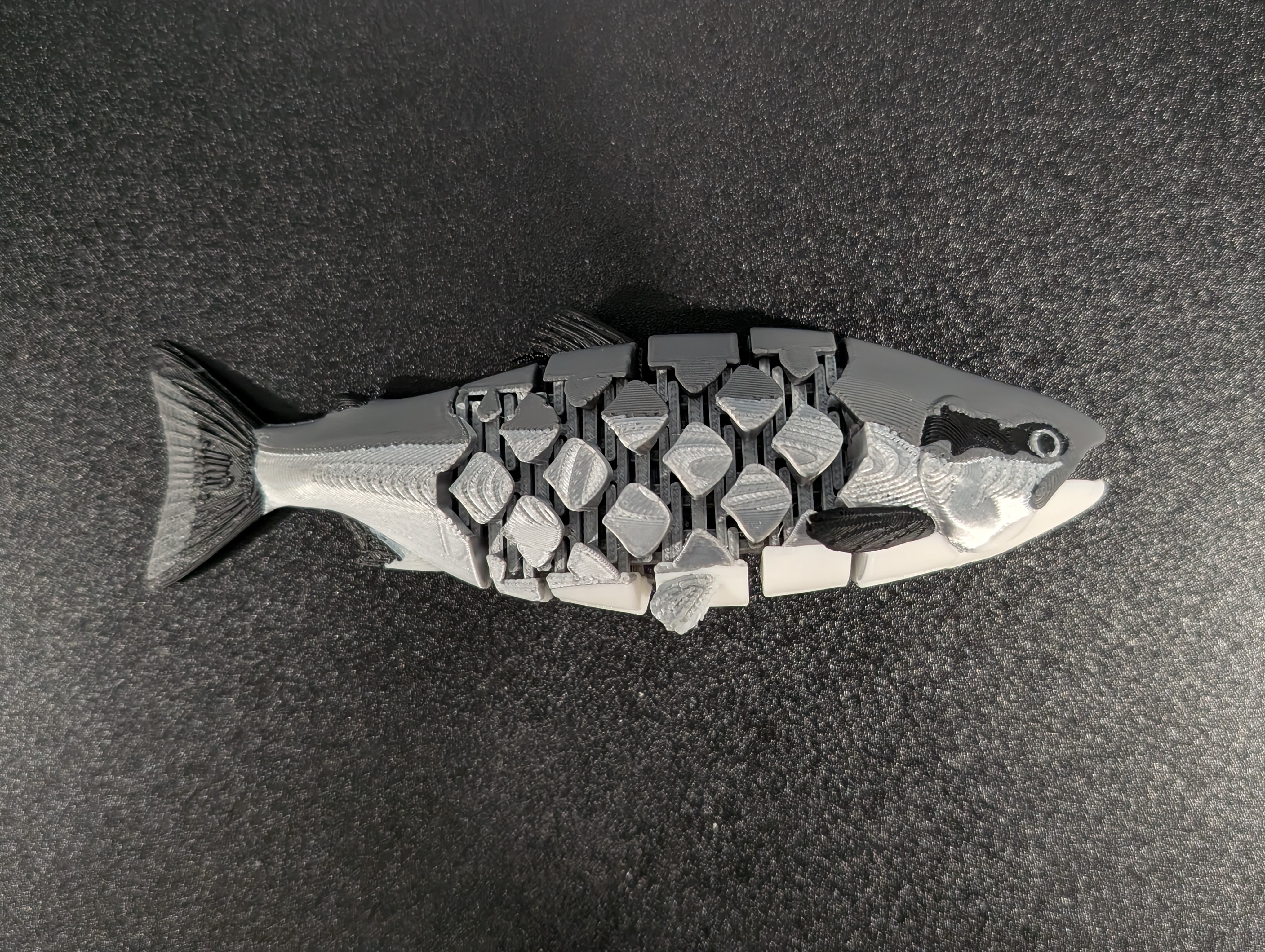
Articulated Sockeye Salmon (2 forms!)
Peso
202g
Tiempo
17h 30m
Precio
Cotiza este producto por WhatsApp
Contáctanos y te damos el precio según color y acabado
Las dimensiones dependen del diseño. Confirmamos las medidas exactas por WhatsApp.
Descripción
Sockeye salmon are a species of highly prized anadromous fish native to Russia, Canada, and the Northeastern United States, especially Alaska. While they are widely popular food (you've definitely seen them at the grocery store) and a symbol of the Pacific Northwest, what makes these fish truly special is their brutal and harrowing spawning migration. After spending 2-3 years at sea they begin the journey back to the exact streams and rivers they were born in, hundreds of miles away. When they enter freshwater they stop eating, the rest of the trip is done on the fat reserves they've built up at sea. After that, their appearance also starts to change. Their chrome scales are replaced with a green head and a bright red body. Males also develop a hump and hooked jaws. During their migration they have to get past waterfalls, predators, and low water levels or shallow creeks, all while their bodies are slowly decaying. Only 1 in 1000 make it back to their home streams to spawn. Females lay 2500-5000 eggs in gravel beds that are then fertilized by the males. The migration is a one way trip, after spawning the adults die having completed their life cycle. During this time the rivers and creeks are littered with the bodies of salmon, but these too have a purpose. As they decay (or are fed on by predators and scavengers) they release all the nutrients they have accumulated out at sea into the environment. Nine weeks later, the eggs will hatch and the cycle begins again. Fishing for sockeye during their migration is such an amazing experience. While I've made many fish models of species I've caught, sockeye are my favorite to fish for. Since they stop eating when they enter the rivers, fishermen use a technique called "flossing". A hook and a bead are placed on the end of a long fly line which are then cast upstream in around 1 ft of water. The bead and hook flow with the current and then at the end of the pass they are ripped perpendicular to the flow of the water. Sockeye swim close to the shore with their mouths open facing upstream. If your hook and bead are lined up right, they fall into the open mouth of the fish, and when the line is ripped the hook flies right into the corner of the mouth. The fish will then take off and your job is to just hold on until it slows down and you can take line back. It's a real forearm workout but it is so much fun! This sockeye salmon model is available in two variations: spawning and chromer. Both use the same interlocking scale units to swim and are assembled in the same way as my other articulated fish models. The halves are aligned with a registration pin and glued together by the flat bottoms of the head, tail, and perimeter scales. Each print profile has the original model on plate 1 plus a keychain variant (hole in the tail) in plate 2. The full-color spawner uses 5 colors, but I've provided a 4-color print profile so it can be printed with 1 AMS. I hope you have as much fun with these models as I did designing them. Happy printing (and fishing)!
Tags
Diseñador
Bruddz