
Solar System true scale, No AMS, No Support
Peso
697g
Tiempo
18h 19m
Precio
Cotiza este producto por WhatsApp
Contáctanos y te damos el precio según color y acabado
Las dimensiones dependen del diseño. Confirmamos las medidas exactas por WhatsApp.
Descripción
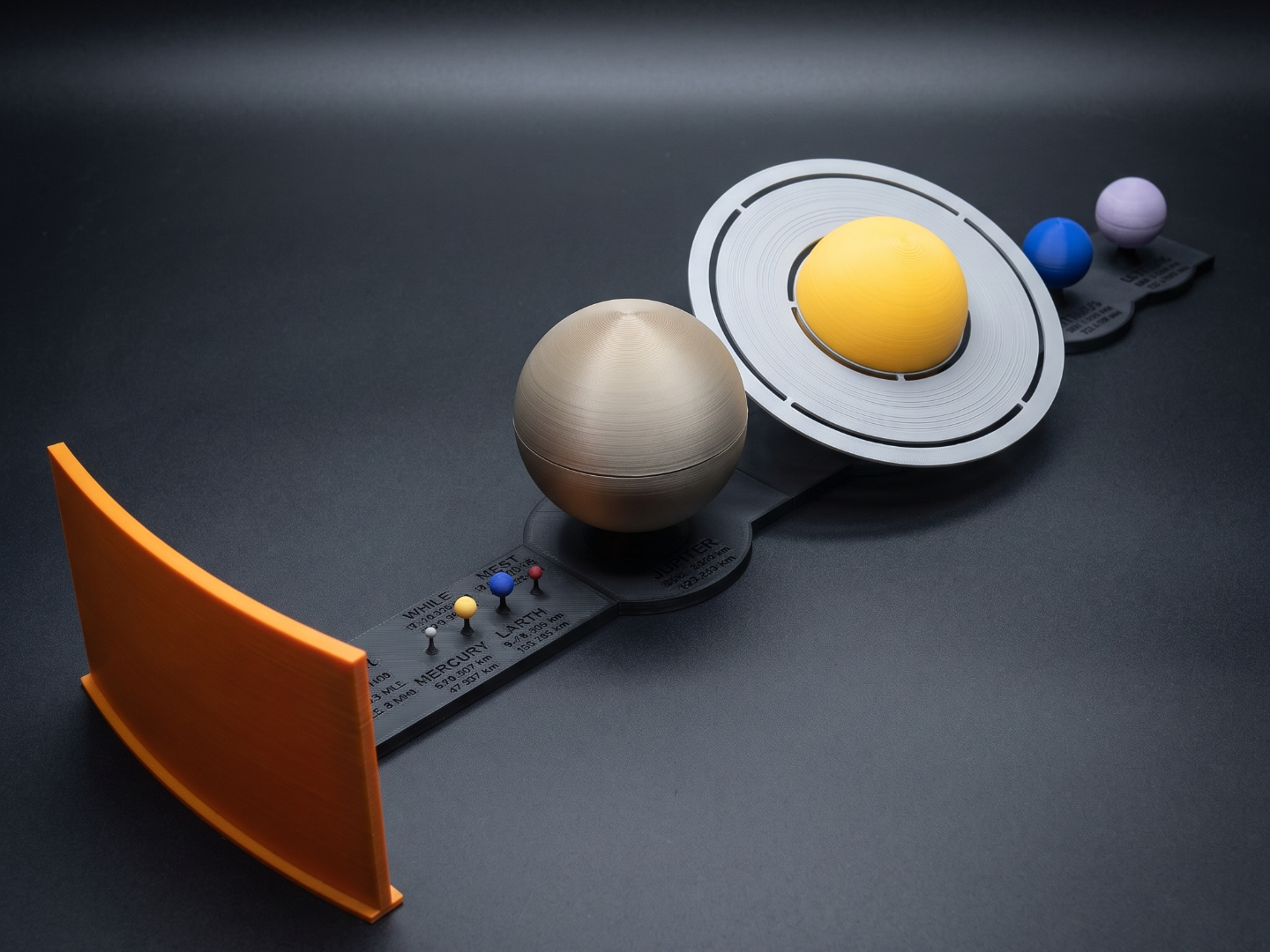
Solar System to Scale The whole solar system on one rail, at one honest scale — and the Sun is the part that didn't fit. Earth prints out at 10 mm, smaller than a marble. Jupiter comes out at 112 mm. Every body was divided by the same single number, 1 : 1,275,600,000, so the sizes are honest all the way across. Nothing was nudged to make the set look nicer on a shelf. The Sun is the part that gets people. At this scale it would be 1,092 mm across, so it cannot be printed at all. What you print instead is a piece of its edge: an orange wall 230 mm wide that curves by only 12 mm over that whole width, standing level with the top of Jupiter. That almost-straight line is the Sun. What is to scale, and what is not. The sizes are exact. The distances are not, and can't be — at this scale Neptune would sit 3.5 km down the road. The real distance is engraved on the rail next to each planet instead, with its real diameter in km. Assembled: 643 × 194 × 132 mm, 34 printed pieces. Mercury Ø 4,879 km → 3.82 mm Venus Ø 12,104 km → 9.49 mm Earth Ø 12,756 km → 10.00 mm Mars Ø 6,792 km → 5.32 mm Jupiter Ø 142,984 km → 112.09 mm Saturn Ø 120,536 km → 94.49 mm, ring Ø 214.44 mm Uranus Ø 51,118 km → 40.07 mm Neptune Ø 49,528 km → 38.83 mm The details Split along the real equator. Jupiter, Saturn and Neptune are cut where their actual equator runs, so the seam between the halves shows the axial tilt. Uranus is the exception — at 97.8° its equator is nearly vertical, so it is split like a globe and its tilt is engraved on the rail. Saturn's rings are to scale too, Cassini division included as a real open gap on four thin spokes. The ring drops over the neck of the lower half and the upper half then locks it in: it can't come off any more, but it still turns. Everything clicks together. Four rail segments, engraved with the title, the scale and every planet's data. Planets push onto their stand and stay put without glue. Every clearance was tuned on printed parts, not guessed. Print Profiles Included Two projects, same 34 pieces, no supports in either. Pick one: A — Full color, no ams, no support.3mf — the planets in colour 10 plates, one colour per plate. 691 g, 18 h 25. Each planet gets its own colour, and because no plate ever mixes two filaments you just swap the spool between plates. No AMS needed, no purge, no prime tower, nothing thrown away. B — Planets single color.3mf — all planets in one colour, to paint yourself 4 plates, two filaments. 595 g, 13 h 51. Every planet, the ring and the Sun wall in white; the rail, stands and dowels in black. Plate 3 holds all twelve planet parts in one go, so it is four plates and you are done — then paint them however you like. Both totals are what the slicer reported for these exact files. Jupiter and the Sun wall are two fifths of version A between them, so don't start there — print the plate with the stands first, then Mars, and check that fit before you commit an afternoon to Jupiter. Printing Recommendations Clean Print Bed (Crucial): Saturn's ring is 214 mm across and only 2.4 mm thick, and the Sun wall stands on a footprint 30 mm deep. Both want a properly clean plate. Material: PLA. Matte reads the engraving much better than glossy. Colors: black rail and stands · grey ring · tan or metal PLA for Jupiter · blue for Earth and Neptune · rust red Mars · white or cream Venus · light blue or lavender Uranus · yellow Saturn · orange Sun. All a suggestion — it is one dropdown per plate. Supports: none, anywhere. Every part already lies flat on its own printing face. Infill: 10–15%, as set in the profiles. Bed size: the Sun wall is 230 mm long and the ring 214 mm across, so you want a 230 mm bed. Everything else fits inside 200 mm. Purge before the light colours if you come off a dark spool. Venus is 9 mm wide; there is nowhere for a streak to hide. Saturn's ring: let it cool completely, flex the plate away from it, and lift it by the hub. The outer ring hangs on four thin spokes. Important Note for First Use The fits are tight on purpose, and a printed hole always comes out a little undersized — so the first assembly is the snug one. Don't worry: twist a ball while you push it down and it seats. If one really refuses, run a drill bit through by hand — 2.2 mm Mercury, 2.4 Venus, 2.55 Mars, 3.0 Earth. Half a turn is usually enough. The big spheres drop half a millimetre as they settle onto their pin; that is by design and it is what sets their height. Assembly Rail: segments 1 → 2 → 3 → 4. The T-tongue drops into the next slot from above — lower it in, don't slide it. Small planets: stand into its recess, ball down over the stem until it stops. Big planets: two dowels into the bottom half, top half on, sphere onto the stand pin. On Saturn, drop the ring over the neck before the top half goes on. Sun edge: stands free on its own flange, wherever it looks best. What's included Full color, no ams, no support.3mf — 10 plates, one colour each Planets single color.3mf — 4 plates, white planets on a black base, for painting 28 STL files, every one already in its printing orientation 💼 Sell my physical prints? Get your Commercial License on Patreon ❤️ Support my work (€2): Get voting power & sneak peeks on Patreon ☕ One-time tip? Sponsor 100g ($2) of filament on Ko-fi
Tags
Diseñador
SimplySolid3D